Bank of China Building
Updated: Apr 11
Introduction
In Hong Kong, whenever the Bank of China is mentioned, the first image that usually comes to mind is Ieoh Ming Pei’s iconic masterpiece, the Bank of China Tower. Yet, forty years before the Tower was completed, the Bank of China’s headquarters in Hong Kong opened 180 meters (600 feet) from its current location. To this day, that building—the Bank of China Building—still stands tall in the heart of Hong Kong, albeit dwarfed by its neighboring skyscrapers; and it still serves as a sub-branch of the Bank of China.
Anyone who has ever visited the headquarters of Bank of China’s main competitor in Hong Kong, namely HSBC, will have noticed that strangely outdated building lost among ultra-modern steel and glass towers. But don’t be fooled by the addresses of both buildings, though. Even though HSBC’s Main Building is located at 1 Queen’s Road Central, and the Bank of China Building’s address indicates 2A Des Voeux Road Central, both buildings are indeed directly adjacent to one another, separated only by the aptly named Bank Street.

Interestingly, between 1959, when the Chartered Bank of India, Australia and China—now known as Standard Chartered—moved to its current location, and May 1990, when the Bank of China moved its headquarters to the Bank of China Tower at 1 Garden Road, no fewer than three of Hong Kong’s five strongest banking institutions—i.e., Bank of China, HSBC, and Standard Chartered—had their headquarters directly adjacent to one another.

In the early 1960s, the French Bank Building, demolished in 1963; the Mercantile Bank Building, acquired by HSBC in 1959; and the Bank of Canton Building, demolished in 1989, filled the gaps left behind. This truly made the area formed by Des Voeux Road, Queen’s Road, and Ice House Street the financial heart of Hong Kong.
This is even more remarkable considering that, as of 2023, HSBC, Standard Chartered, and Bank of China are the only three remaining commercial banking institutions authorized to issue banknotes in Hong Kong; though Bank of China was granted that right only in 1994, four years after moving their headquarters to the Bank of China Tower.
History of Bank of China (Hong Kong)
In February 1912, following the approval of Dr. Sun Yat-sen, the Bank of China was officially established in Beijing.
Five years later, on September 24, 1917, the Hong Kong branch of the Bank of China began operations in rented premises at 47 Bonham Strand East. Pei Tsu-yee, father of Ieoh Ming Pei—who would later design the iconic Bank of China Tower—became the first branch manager of the Bank of China (Hong Kong).
In February 1919, the Bank of China moved to 20 Connaught Road. It later relocated in September 1921 to a six-storey building at 4 Queen’s Road Central—a site that, until 1890, housed the Chartered Bank of India, Australia, and China, known today as Standard Chartered Bank.
Thirty years later, in 1951, the Hong Kong branch of the Bank of China moved to the Bank of China Building, which served as their headquarters for nearly forty years before relocating to their current headquarters, the Bank of China Tower.
The move to the Bank of China Building in 1951 marked the end of the bank renting the building or the land on which its Hong Kong headquarters were situated. Since then, the bank has owned both the land (albeit through a lease) and the building from which it operates.
History of Bank of China Building
Anyone who has had the chance to visit Hong Kong, Shanghai, and Singapore may (or may not) have noticed the striking similarities between the Bank of China Buildings in each of these cities—so much so that even the names of these three buildings are identical: Bank of China Building. Obviously, these similarities are not a coincidence.
Bank of China Building (Hong Kong), Bank of China Building (Shanghai), Bank of China Building (Singapore)
The three buildings were designed by the Hong Kong-based architectural firm Palmer and Turner in the early 1930s, during the height of the Art Deco movement. The first of these buildings to be constructed was the Head Office and Shanghai branch, located on the Bund, amidst prominent Western financial institutions of the time. To oversee the construction, the Bank of China established a Special Management Council, chaired by Pei Tsung-yee.
Construction of the Bank of China Building in Shanghai commenced on October 10, 1936, and was topped out in 1937. However, the outbreak of the Second Sino-Japanese War later that year delayed its completion. In Hong Kong and Singapore, on the other hand, the Japanese invasion halted the construction of the remaining two buildings altogether.
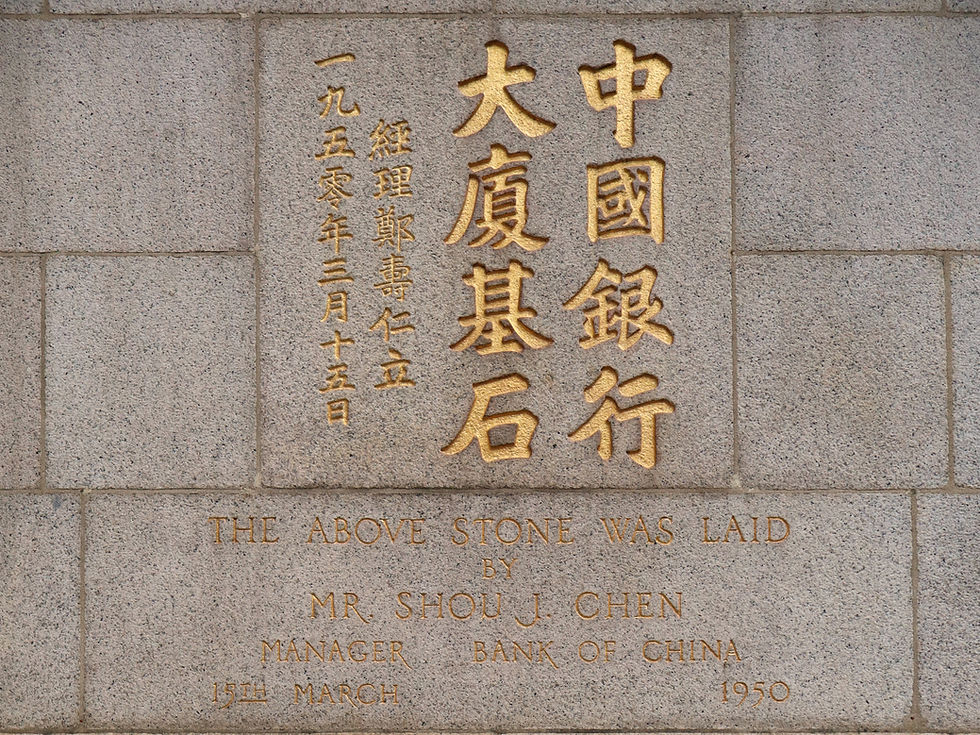
The foundation stone of the Bank of China Building in Hong Kong was eventually laid on March 15, 1950, and the building was completed in 1951. Three years later, in 1954, construction of the Singaporean Bank of China Building was also completed.
Upon completion, the Bank of China Buildings in Hong Kong and Singapore were the tallest structures in their respective cities. In Shanghai, however, although the initial design envisioned a 34-storey building, businessman Victor Sassoon insisted that no building could be taller than the spire of his own building, Sassoon House—better known today as the Fairmont Peace Hotel. As a result, the Bank of China Building in Shanghai was redesigned to be one foot shorter than Sassoon House.
2A Des Voeux Road
As briefly mentioned in the introduction, although the Bank of China Building and HSBC Main Building are adjacent to one another, their respective addresses may suggest otherwise. In reality, the very address of the Bank of China Building is a remnant of Central’s highly dynamic past.
In fact, when HSBC opened their first branch in the long-since demolished Wardley House, located at the site of their present-day headquarters, Des Voeux Road Central did not yet exist.
Looking at a map of 21st-century Hong Kong, it may seem odd, but before extensive reclamation projects were initiated, HSBC’s headquarters stood on the shoreline of Hong Kong Island. Since the day HSBC opened their first branch, the address of their headquarters in Hong Kong has remained unchanged.
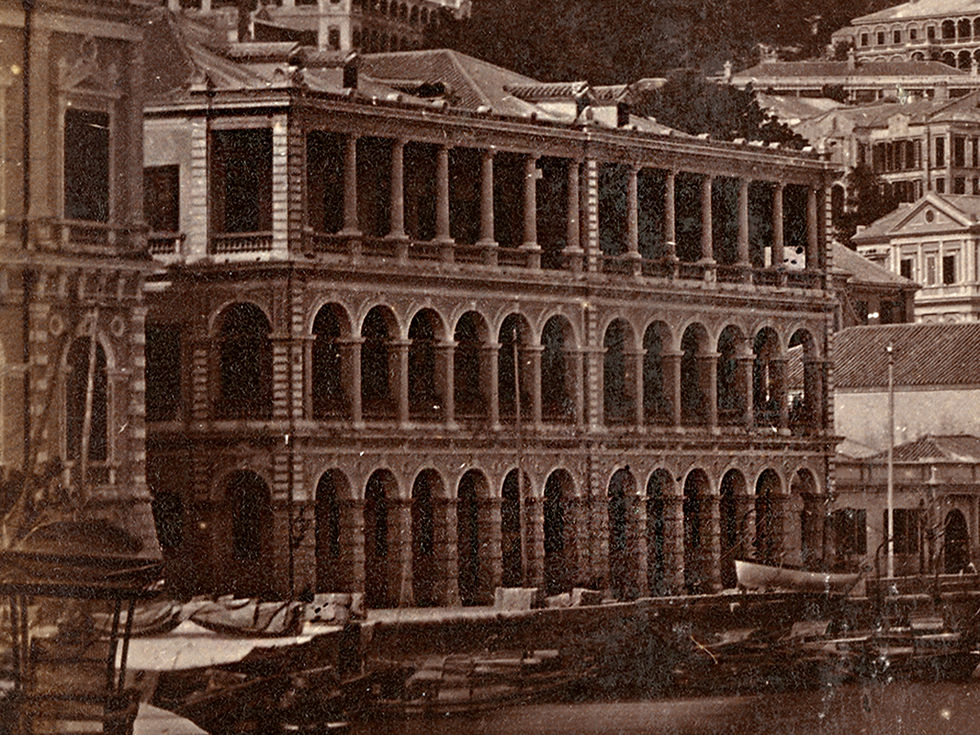
However, by the time the Bank of China had their headquarters built, reclamation projects along with urban development had dramatically altered the topography of Hong Kong Island. Bank of China Building’s address directly reflects this. Indeed, 2A Des Voeux Road Central indicates that the building was constructed on a plot of land that had been previously subdivided.
In 1867, the Old City Hall of Hong Kong was completed on a plot of land now occupied by the Bank of China Building and parts of the HSBC Main Building. However, in 1933, the western part of the Old City Hall was acquired by HSBC, then known simply as the Hongkong and Shanghai Bank. This section of the building was subsequently demolished to give HSBC extra space to construct its Third Generation HSBC Building, completed in 1935.

Twelve years later, in 1947, the temporary library section of the Old City Hall (eastern part of the Old City Hall) was demolished. In its place, the Bank of China Building was constructed. Construction began in 1949, coinciding with the rise to power of the Communist Party of China on the Mainland.
Bank of China Building and HSBC Main Building
This “shared” plot of land initiated a long history that would link the successive headquarters of Bank of China in Hong Kong to that of their main competitor, HSBC.
As a Chinese banking institution, Bank of China's headquarters immediately became a propaganda tool designed to symbolize Communist supremacy in Capitalist Hong Kong. Upon completion in 1951, the Bank of China Building stood approximately 7 meters (24 feet) taller than the Third Generation HSBC Building, making it the tallest building in the British colony throughout the 1950s until it was surpassed by the Mandarin Oriental in 1963.

The similarities do not end there, though. The Third Generation HSBC Building was designed by the Hong Kong-based architectural firm Palmer and Turner; the Bank of China Building was also designed by Palmer and Turner. Additionally, the Bank of China Building was constructed by the British firm Wimpey Construction. The current HSBC Building was built by Wimpey Construction as well, albeit as part of a joint venture.
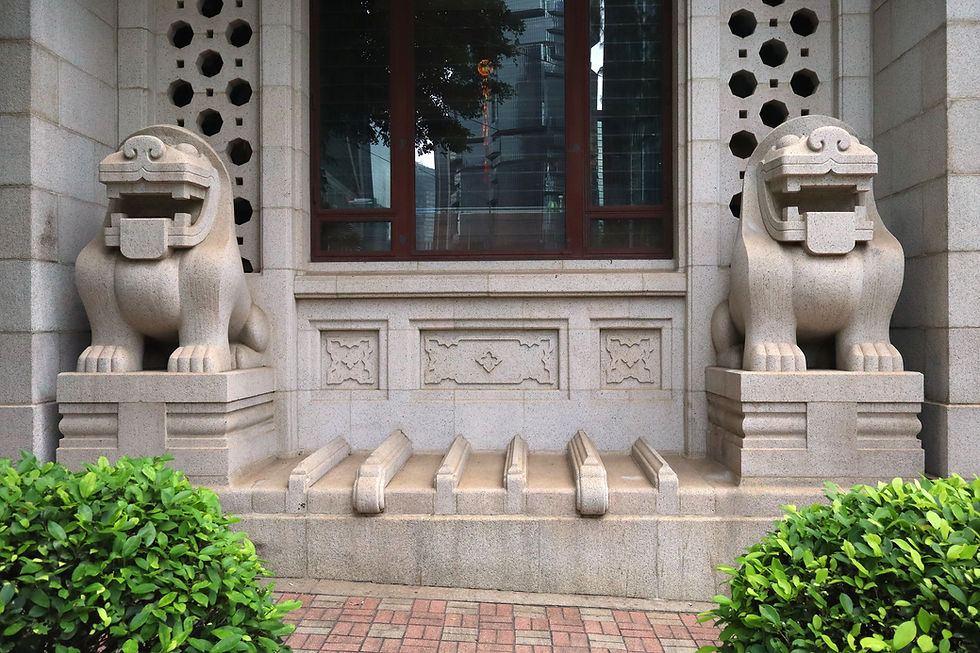
Last but not least, similar to the HSBC Main Building, the Bank of China Building is protected by two lion statues flanking each side of its main entrance on Des Voeux Road Central, which, according to Chinese belief, scare away demons and protect businesses from evil spirits.

However, unlike HSBC, which had its third-generation building torn down to make way for its current headquarters, Bank of China acquired a nearby plot of land to build the Bank of China Tower and kept their original headquarters intact. As of 2023, the Bank of China Building still houses the Central sub-branch of Bank of China, as well as the exclusive China Club, located on floors 13 to 15.

Architecture
Yet another similarity between the Bank of China Building and HSBC’s Third Generation Building is their architectural style. Designed in the 1930s, both buildings (along with the Bank of China Buildings in Shanghai and Singapore) were constructed in the Art Deco style, which was very popular in Europe and the United States at the time.
However, due to the delayed construction of the Bank of China Building as a consequence of the Second World War, it was completed in 1951. By that time, the building immediately felt outdated. This was even more apparent as modern, streamlined buildings began appearing all over Central from the 1960s onward.
As stated in the Historic Building Appraisal Number 89, published by the Antiquities Advisory Board, the façades feature setbacks and are strongly emphasized vertically by mullions and columns rising to unite the bands of windows at various floor levels. The facing is granite, and ornamentation is limited to the carved cappings of the columns, stylized frieze decorations, and ornamental panels adjacent to and below the windows.
Today, a total of four granite lion statues guard the Bank of China Building: two lions at the main entrance on Des Voeux Road Central, sculpted in the traditional Chinese style, and two lions sculpted in the Art Deco style by Italian artist Rodolfo Nolli on the side of the building where Queen's Road Central and Des Voeux Road Central merge into Queensway.
Originally, the main entrance of the Bank of China Building was not guarded by the Chinese-style lions we are familiar with today but by another pair of Art Deco lions, also sculpted by Rodolfo Nolli. In fact, Nolli had created a set of eight lions: four for the Hong Kong Bank of China Building and another four for the Singaporean Bank of China Building.
However, by the time the Bank of China Building was completed in 1951, the Communist Party had come to power in mainland China (October 1, 1949). Unhappy with the modernist and undeniably foreign Art Deco lions guarding their bank building, they had the two lions at the entrance removed and donated to Hong Kong University, where they still reside to this day. As for the lions on the eastern façade of the building, they could not be removed, as they form a structural part of the building, and they still remain in place.
Although the exterior of the building remained relatively intact, the interior has undergone numerous modifications. In 2017, parts of the Bank of China Building’s interior received its latest renovations. The architect responsible for the design was Pei Li-chung, who is the son of Ieoh Ming Pei, the architect of the Bank of China Tower, and the grandson of Pei Tsu-yee, the first branch manager of the Bank of China in Hong Kong.
Propaganda
Ever since its completion, the Bank of China Building has played a pivotal, yet ambiguous, role in the relations between Communist China on the one hand and Capitalist Great Britain and the Western world on the other. If the Communist regime needed Hong Kong to funnel money overseas through the Bank of China Building, it also, at times, used the building as a giant pro-Communist and violently anti-Capitalist billboard.
The Bank of China Building, standing 7 meters (24 feet) taller than the HSBC Third Generation Building, for instance, was not a coincidence resulting from architectural imperatives. Instead, it resulted from direct instructions given to Palmer and Turner to design the headquarters of a Communist bank that would stand taller than its Capitalist counterpart, thereby symbolizing the supremacy of Communism over Capitalism.
More striking, however, are the events that took place in Hong Kong between 1966 and early 1968. As Mao Zedong had just unleashed his Cultural Revolution in Mainland China, pro-Beijing riots erupted in Hong Kong.
In 1967, anti-British banners were hoisted on the Bank of China Building, while loudspeakers blared anti-British slogans as protesters gathered on Garden Road, only a stone’s throw away from the building.

It was further revealed that then-Chinese Premier Zhou Enlai had encouraged the riots in Hong Kong by sending 12 million HKD to pro-Beijing protesters through the Bank of China, although he later expressed official disapproval of the riots. By that time, 51 people, including 15 civilians, had been killed.
Conclusion
Ever since the completion of the iconic Bank of China Tower, the Bank of China Building may have ceased to serve as the headquarters of the Hong Kong branch of Bank of China. However, it remains a stark reminder of what Hong Kong once was: a Western-ruled capitalist territory on the doorstep of a Communist giant, heavily influenced by this formidable neighbor.
More than just a silent witness to changing times, its very existence has been directly shaped by history. Designed in the 1930s, during the height of the Art Deco movement, its survival was threatened by the Japanese invasion. It was only after the Communist victory in mainland China that its completion became possible.
Throughout its life, the Bank of China Building served as a giant billboard and loudspeaker—sometimes literally—for the Communist Party of China in Hong Kong, overlooking its capitalist neighbors, even if only by a few meters.
Today, the Bank of China Building has lost its former grandeur. Once a prominent fixture at the forefront of Hong Kong’s financial scene, it has gradually fallen into irrelevance over the decades—losing its title as the tallest building in Hong Kong and becoming a relic of the past, overshadowed by modern skyscrapers soaring hundreds of meters taller than Bank of China Building.
Yet, its prime location at the junction of Des Voeux Road and Queen’s Road—two of Hong Kong’s main streets—ensures that this piece of the city’s legacy cannot be overlooked. It stands as a reminder of its rich historical significance as the headquarters of one of Hong Kong’s leading banking institutions, as well as a witness to the city’s evolution through the second half of the twentieth century and into the twenty-first.

Comments